MQL, SQL and PQL: qualifying leads in the funnel
Three acronyms describe a lead's path to becoming a customer. Understanding each one helps you adjust your marketing, sales and product actions.
Product7 min read

When it comes to growth and sales strategies, a few terms come up often but can cause confusion: PQL, MQL and SQL.
These concepts are essential to understand the path a lead takes from the first contact with your solution until they become a customer. Each one represents a different stage of the conversion journey and, once you understand them, your team can adjust its actions and strategies to improve sales efficiency and success. Let's explore what these acronyms mean and how they apply to your customer acquisition process.
This text about PQL, MQL and SQL is aimed mainly at marketing, sales and product professionals, especially those working at B2B (business-to-business) or SaaS (software as a service) companies. These terms are widely used by teams that handle lead generation and qualification, as well as the development of customer acquisition and retention strategies.
What is an MQL (Marketing Qualified Lead)?
A Marketing Qualified Lead (MQL) is a lead who has shown interest in what your brand or product offers, usually as a result of marketing actions. This type of lead is more likely to become a customer than others.
Typically, an MQL is someone who has actively engaged with your brand by doing things like providing contact information, signing up for software or a newsletter, adding items to a shopping cart, downloading content or visiting your site several times. These leads are promising, curious and interested in your business, but they are not ready to buy yet. Still, they are more receptive to a sales approach than an average lead.
Think about your own buying experience: you rarely give out your real email unless you're open to a conversation or to digging deeper into the product.
Put simply: Marketing Qualified Leads turn into Sales Qualified Leads (SQLs), who can then become customers. The main behavioral attributes for building a qualification strategy for MQLs are:
- Downloading a trial version of software or a free ebook
- Using software demos
- Filling out online forms
- Subscribing to a newsletter or email list
- Favoriting items or adding items to a wishlist
- Adding items to a shopping cart
- Visiting your site repeatedly or spending a lot of time on it
- Clicking an ad to find your site
- Getting in touch to ask for more information
What is a PQL (Product Qualified Lead)?
A Product Qualified Lead (PQL) is a lead who has experienced meaningful value using your product through a free trial or freemium model. Their purchase intent is based purely on how well your product has proven to be a solution for them.
For a lead to count as a PQL, they must have actually used the product; if a lead only signed up for a free trial or a freemium service, they would not be considered a PQL.
As a result, PQLs are more likely to become customers than other leads. Unlike Marketing Qualified Leads (MQLs), whose purchase intent is based on arbitrary factors like email opens, ebook downloads and web page visits, PQLs are tied to meaningful value.
Each company has its own PQL criteria, which determine what stage of the buying cycle the lead is in. Below are some behavioral attributes for building a PQL qualification strategy.
- Opening and activating a sign-up account
- Reading IT support articles
- Talking to support reps
- Frequency of trial use
- Trying the main features
- Introducing teammates to the account
- Taking advantage of onboarding (for SaaS products)
- Adding a payment method
- Visit quota goals
Here are some examples from well-known companies:
- For Slack, a PQL is when an account reaches the limit of 2,000 messages.
- For Facebook, it's when someone adds 7 friends.
- For Drift, a PQL is when someone has 100 conversations on the site.
What is an SQL (Sales Qualified Lead)?
A Sales Qualified Lead (SQL) is a prospect who has been identified as ready and willing to buy your products or services. This means they have already interacted with the brand, by filling out a form on the site or taking part in another initiative, and have shown enough signs of interest to suggest they are more likely to become a paying customer.
The concept of an SQL is very different from a Marketing Qualified Lead (MQL), who is a person that has expressed initial interest but may not be ready to buy yet. MQLs need more nurturing before they are considered ready for sales.
Sales Qualified Leads (SQLs) are crucial contacts for any company looking to grow and expand in its target market, since these leads have already been vetted by the marketing team and have shown a certain level of interest in the company's product or service. They are therefore much more likely to convert into real paying customers.
Each company has its own qualification criteria, but for a lead to be an SQL, they must have shown enough intent to buy your products/services. By focusing on SQLs, the sales team can spend more time closing deals instead of trying to generate new leads from scratch, using its time and resources more efficiently and contributing to higher overall revenue.
Typically, SQLs progress from MQLs or PQLs (in the B2B case).
Differences Between PQL, MQL and SQL
The table below will help you gain deeper insight into MQL vs SQL, PQL vs MQL and PQL vs SQL. It gives a clear picture of each lead stage in the customer journey, their intent and their level of interest in becoming a paying customer.
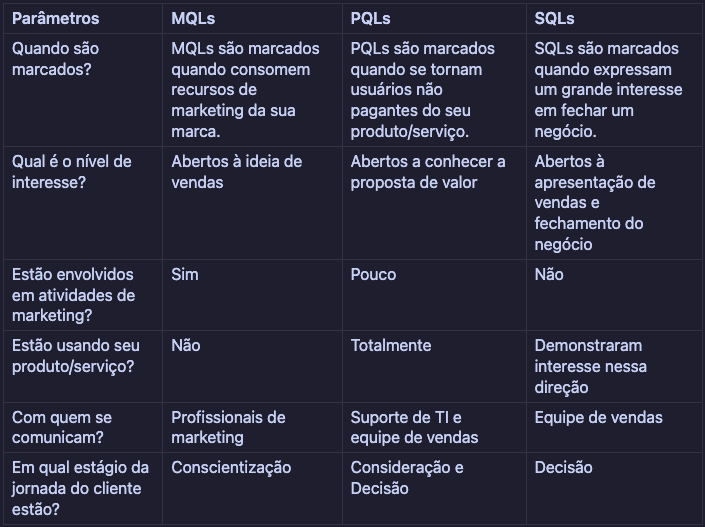
Now, to understand the differences better and leave no doubt:
- PQL (Product Qualified Lead): A lead who has already experienced real value using the product through a free trial or freemium. They are more likely to convert because they have already understood the product's value.
- MQL (Marketing Qualified Lead): A lead who has shown interest based on marketing actions, like opening emails or visiting pages, but is not ready to buy yet. Their engagement is more superficial.
- SQL (Sales Qualified Lead): A lead who is further along in the sales funnel, having shown a clear intent to buy, usually after review by the sales team.
In short, the PQL is about experiential value of the product, the MQL about interest from marketing interactions, and the SQL about strong purchase intent.
From MQL to PQL and SQL: The Lead Qualification Flow in One Step!
To understand the flow of MQLs, SQLs and PQLs, let's look at a typical funnel in the B2B space. Here is a visual representation of the qualification flow for MQLs, SQLs and PQLs.
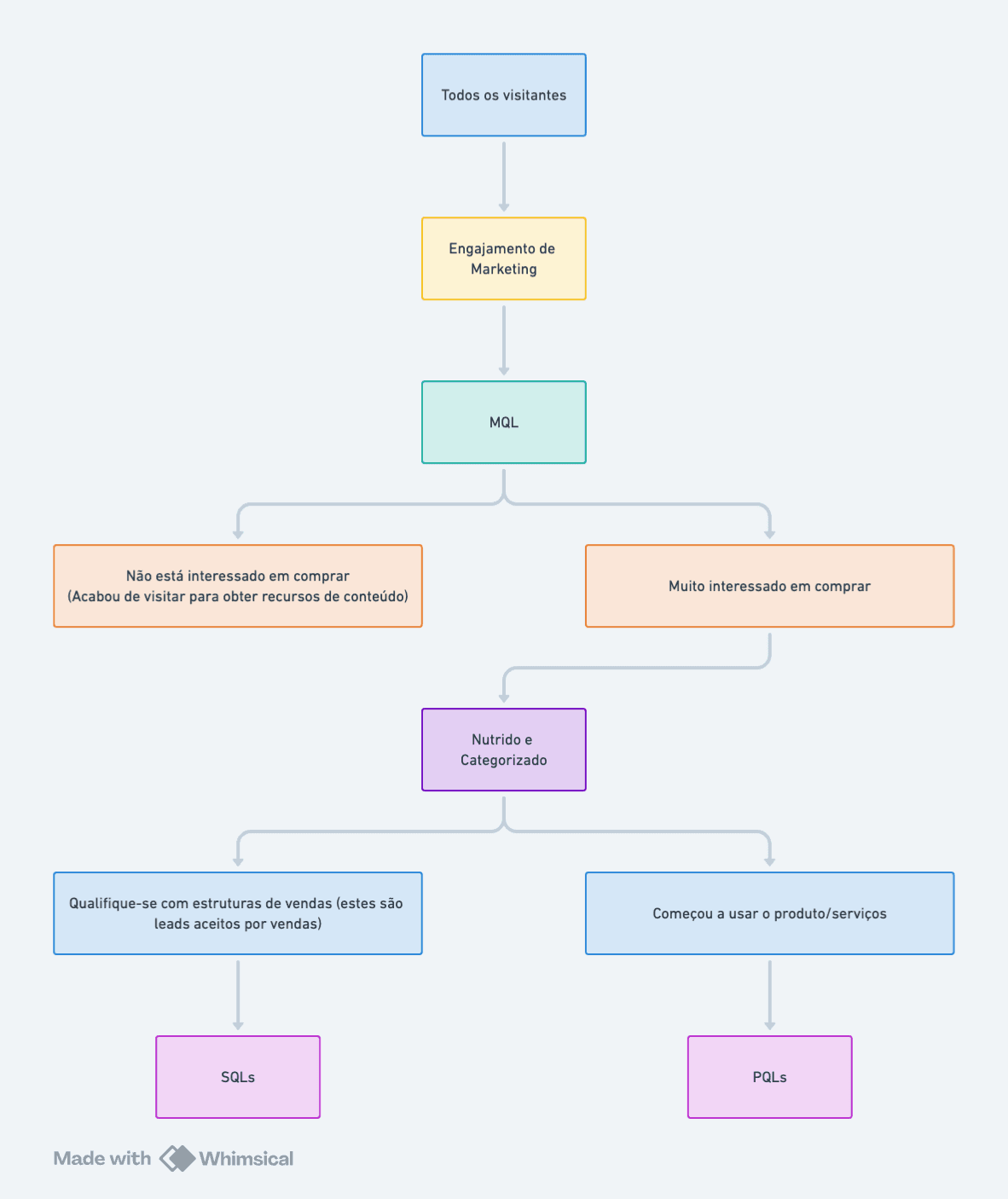
Visitors arrive at your site through various lead generation and inbound marketing initiatives (ads, social media, content, etc.).
At this first stage, they start showing interest in your brand through engagement activities like visiting your site, reading blogs, watching videos, downloading resources, attending webinars, etc.
Those who meet the lead qualification criteria set for MQLs are considered a good fit for this nurturing. Those who don't meet the criteria are considered unqualified leads.
MQLs are then nurtured. This lead nurturing helps you get to know your customers better for more effective sales targeting. Salespeople start interacting with these leads and trying to qualify them with various qualifying questions.
Then, with each positive answer to the qualifying questions, these sales-accepted leads progress to SQLs or unqualified leads. Your reps also need to engage these SQLs to convince them to buy or to try the product for free.
Sales qualification is a key step in creating opportunities, and the best way to do it is to follow a qualification framework. Some MQLs become well acquainted with your products/services through your aggressive marketing. So they sign up for a free trial and end up becoming users. Thus, once a lead starts using your product/service, they land on the PQL list.
Most PQLs often convert into paying customers on their own.
Can You Automate Lead Qualification?
Yes, you can automate your lead qualification process for MQLs and PQLs.
But SQLs usually communicate verbally with sales reps, so we can't define qualification criteria. See the table to check on what basis we qualify MQLs.

Leads are qualified based on engagement and profile fit. So, once a lead reaches the lead score threshold, they will be automatically qualified.
Then your marketing team sends them to the sales team to qualify them further through multiple efforts (sales calls, text and email sequences).
Here is the step-by-step takeaway:
With a lead scoring model tool, you can set up lead qualification as MQLs in automatic mode.
For example, you can qualify leads automatically based on email engagement; you can set up email activity triggers (clicked, opened, replied, etc.) and assign scores to each condition, so your software automatically takes action and assigns scores to the lead for qualification.
Conclusion
Understanding and correctly applying the different types of leads — PQL, MQL and SQL — is essential to optimize the sales funnel and deliver better results. Each of these leads reflects a different level of engagement and purchase intent, allowing for more targeted and effective strategies.
Using PQLs helps you focus on leads who have already experienced the product's value, increasing the chances of conversion. MQLs let you nurture leads who are still in the consideration phase, while SQLs signal opportunities that are ripe for closing. Aligning these classifications with your marketing and sales strategies ensures your effort goes to the right opportunities, maximizing efficiency and conversion rate.
Originally published onMedium(opens in a new tab)
Keep reading
UX2025
Product2024