Users, contexts of use and scenarios in UX
Mapping the user experience comes before any UX roadmap. Here are personas, user types, the context of use and the usage scenario, and how they fit together.
UX11 min read
Mapping the user experience is a fundamental step in building an effective UX roadmap, but it is far from a simple or quick task. To do it, you need to understand how online media currently works within the segment of interest and recognize how fast it evolves (a topic we will explore in more depth in an upcoming article). This scenario demands that we set aside conventional approaches, where a few communicate to many, and adopt a more collaborative, user-centered view.
On top of that, Cognitive Psychology plays a crucial role in this process, helping us understand and map the mental models of the different types of users. That understanding lets us create strategic triggers and artifacts that boost the experience of the product, site or service, making sure the value proposition is clear, relevant and well executed.
Introduction: how does online media work?
Before exploring online media, it is important to understand that there are two main types of media: Analog Media and Online Media.
Analog Media refers to the traditional channels for distributing content, such as television, radio, newspapers, magazines and other physical outlets. For a long time, these were the main tools of communication and advertising.
Online Media, which is the focus in UX, works differently: content is distributed digitally, through electronic devices such as computers, tablets, smartphones and smartwatches. The internet creates a vast advertising space that serves as a vehicle for announcements, promotions of products and services, and campaigns. This digital landscape paves the way for what we call Digital Marketing, enabling more dynamic, personalized and measurable interactions between brands and consumers.

by Mantas Gr
Digital Marketing, based on publishing content on digital platforms, brought several advantages and changed the working model of many companies. One of the main changes is how easy it is to collect and analyze data, which allows results to be measured precisely. That makes an even stronger focus on the user possible, promoting a stronger and more direct interaction and nearly immediate feedback, along with benefits such as low cost, easy personalization and more agility in adapting strategies.
It is worth noting, though, that marketing and communication are not the same thing — a distinction that deserves a deeper discussion (and I am happy to talk more about it).
Selecting and validating Personas through conceptual mapping
In UX, Personas represent groups of users whose mental models converge. They are the users who share similar behaviors, needs and goals when interacting with a solution. This lets us work with the same triggers, interactions and navigation flows, optimizing the experience to reach the desired results.
In short, Personas group individuals who share a common view of a specific problem, desire or situation, serving as a strategic guide to create more targeted and effective solutions.
For a designer's efforts to succeed, you need to make sure every member of the product team understands at least the fundamental characteristics and needs of their users, or a lot of time will be spent talking in circles.

by Seth Eckert for The Furrow
Collecting data and bringing together a representative group of users is a challenging and extremely valuable process. It is natural that, over the course of the studies, some information gets lost, or that we end up, without noticing, shifting focus away from the real people who will be the basis for creating the Personas.
On that note, it is important to talk about the mental model. Mental models are tools widely used in the natural and social sciences to represent complex phenomena through abstractions. In the context of UX, mental models do not represent real people, but are grounded in their behaviors, motivations and interaction patterns. For those who want to go deeper, I wrote more about this in another article (worth a look!). And, of course, I am happy to talk through any questions or points of interest.
How do we select these Personas in UX?
The process of selecting Personas in UX starts by identifying the distinct aspects of users, such as their activities, attitudes, aptitudes, motivations and skills. To get it right, it is essential to deepen your knowledge of the target audience segment, using tools such as market research, interviews, behavioral analysis and A/B test data.
From that data, we run a kind of “knockout tournament”, filtering the information until we reach the Personas that best represent the audience's behavioral patterns and needs. These Personas serve as a strategic guide, making sure design decisions focus on who really matters: the user.

by Seth Eckert for The Furrow
With this process, we can validate our conceptual mapping. Once the Personas are selected and identified, it becomes easier to define clear goals that will guide the solution through design.
In the book Emotional Design, by Donald (Don) Norman, three levels of cognitive processing that influence users' interactions are described:
- Visceral: an immediate, emotional reaction to stimuli, even before an action takes place.
- Behavioral: the main focus of interaction designers, it is tied to usability and to the practical experience during use.
- Reflective: involves conscious reflection based on past experiences and on the deeper impact of the product or service.
Below, I present some behavioral factors that help us better understand users' motivations and decisions.
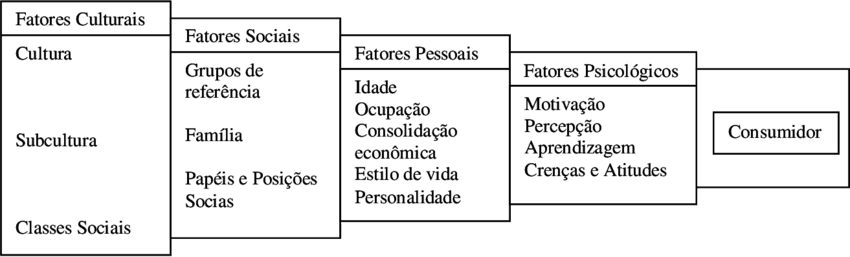
Factors Influencing Consumer Behavior, Philip Kotler
Personas are not static; they should be updated over time whenever there is a need, whether because of changes in the market or in the project itself. Based on the studies carried out, it is possible to classify users within the proposed conceptual model, organizing them into three categories:
- Primary: the main users, those who interact directly and most frequently with the product or service.
- Secondary: users who interact less frequently or indirectly, but whose experience still influences the success of the solution.
- Tertiary: those who do not use the product directly, but are affected by it or have influence over its adoption.
This classification helps prioritize efforts and align the design with the needs of each group.
Primary Users

by The Furrow
The primary user is, essentially, our “target audience” — the main group we need to observe and understand to enter the market successfully. These are the users who will actually use the product or solution we are creating, which makes them the central focus of strategic planning.
They can be our direct customers or our customers' customers, depending on the project's context. This is the group where we concentrate all efforts, actions, triggers and motivations, making sure the product or service meets their needs and expectations effectively.
Secondary Users

by Seth Eckert for The Furrow
We, as UXers, designers, strategists, UX writers, developers and the whole team directly or indirectly involved in the project, are considered secondary users. This also includes stakeholders, that is, those who have a broader view of the project and take part in strategic decisions.
Understanding secondary users lets us clearly separate the strategic mapping. This separation is essential to aim actions, triggers and motivations specifically at the users who really add value — the primary users.
This understanding is crucial to avoid a mistake common in many UX projects: mixing up primary, secondary and tertiary users. Ignoring these differences can compromise the strategy and the success of the solution. The separation is not only critical but also extremely beneficial, because it forces those responsible for the project to see their users with greater clarity and depth.
That way, the focus shifts from “it has to be this way because I want it to be” to “it has to be this way because users showed it is necessary”. That change of perspective is a game changer for making sure decisions rest on real data and on the audience's needs.
Tertiary Users

Tertiary users are sometimes the “strangers” in the process — those who were not planned for, tested or considered when the content and strategy were created. Although unexpected, they can be a valuable source of insights.
The appearance of this group can have a negative or a positive impact. On one hand, it can signal flaws in the initial approach; on the other, it can represent opportunities to explore new cycles and paths for the proposed solution.
Recognizing and analyzing tertiary users is essential, because they can bring unexpected perspectives that widen the reach and effectiveness of the solution.
Context of use, triggers and motivations
Briefly, the context of use is directly related to triggers, that is, everything that leads the user to act and interact with the product or solution. These triggers can be influenced by cultural, social or environmental factors specific to the user, which makes understanding these elements essential for technological evolution and for the success of a new product in the market.
The context of use is therefore one of the most important topics in creating a product, because it defines how, where and why the user interacts with the solution. A careful analysis of this context makes sure the product meets the audience's real needs, is functional and has a clear value proposition.

by Seth Eckert for The Furrow
To guide this process, a few key questions can be asked:
- Is your solution/product really useful to the primary users?
- At what moment and in what context will it be used?
- Is it something new, or does it offer significant improvements over competitors' solutions?
- How much effort and value will the user need to invest to reach and use your solution/product?
These questions help align expectations and make sure the product is relevant, accessible and impactful for users.
Usage scenario, technology used by the primary/tertiary user
As the name suggests, the usage scenario is about the technologies the primary user (and, eventually, the tertiary user) will need to connect and interact with your solution or product. This concept covers aspects such as the devices that will be used, their mobility, responsiveness and connectivity.
Documenting and studying these elements is essential, because they provide important parameters for defining well-structured, mature usage scenarios within the project. These scenarios should take into account the real conditions of access to and use of the product, making sure it works effectively in the different situations users face.
By cross-referencing the information from the usability study, we can analyze the coherence between the contexts (how, where and why the user acts) and the usage scenarios (the technical and practical conditions that support that action). This alignment is fundamental to making sure the user experience is smooth, accessible and well adapted to the audience's needs.

by Seth Eckert for The Furrow
If the technologies used do not deliver what they promise, resulting in an immature scenario, and if the context of use does not make sense for completing the main task, the project faces serious challenges. For example, there is no reason to change the location of a button if its usefulness is questionable for the primary user's triggers. In that case, usability tests may end up generating little or no relevant data, undermining the value of the study.
To get well-defined and effective usage scenarios, we can answer a few key questions:
- Which connectivity technology will be used? It is important to understand whether the solution depends on the internet, Bluetooth, NFC or other technologies, and whether they are accessible to the audience.
- Which devices will be used to interact with the solution/product? Knowing whether the audience will use smartphones, tablets, computers or specific devices helps design responsive, adaptable interfaces.
- Is the market mature enough to receive and sell this solution? Assessing how ready the market and users are to adopt the technology is essential to align expectations.
- What is the learning curve to use it? Will the primary user need to build new habits or study to use the solution? If so, you need to assess the effort required and how to minimize barriers.
By answering these questions, we can better align the usage scenarios with the user's context and identify gaps that need to be solved before the solution launches. That way, we make sure design decisions are based on concrete data and real needs, making the project more robust and relevant.
The relationship between Context and Usage Scenario

by Seth Eckert
By understanding the product's context and usage scenario, we can move on to what we call evaluating and measuring interface quality. At this stage, it is common to find problems related to flows and interactions.
These problems often come from a failure to understand the primary user's mental model from the start of the project. In other words, if the user does not recognize the product's main value proposition or benefit, they will find no reason to use it, no matter how “usable” it is.
This kind of problem is often mistaken for “usability errors”, but it is actually more about product strategy. It is not about the placement of triggers, artifacts or navigation, but about a flaw in the strategic proposal, one that is often forgotten at the start of the project and directly affects the user's perception.
To close, it is worth saying a little about the concept of Affordances. A product's real intention is not only to teach how to use it, but why it should be used. For a product to succeed, usability (how it works) and usefulness (the value it delivers) must go hand in hand, from the beginning to the end of the project, as success metrics.
**I hope you enjoyed it, and thank you for reading! 🤟🏼
**Follow me on LinkedIn: https://www.linkedin.com/in/murilofsouza/
Caelum https://www.caelum.com.br/apostila-ux-usabilidade-mobile-web/personas/#o-que-personas-no-representam
ESPM —MBA em Gestão e Estratégia em UX
Originally published onMedium(opens in a new tab)
Keep reading
UX2025
Product2024